Capital follows infrastructure, and nowhere in Pakistan is that clearer right now than the twin cities. Rawalpindi real estate investment has moved from a word-of-mouth game to a data-driven one in 2026, with buyers comparing corridors, yields and approval statuses the way stock investors compare balance sheets.
This piece maps where the growth actually is: the corridors being transformed by new roads, the shift toward vertical construction, what rental income realistically looks like, and the ground rules that separate patient investors from stuck ones.
What Is Fueling Rawalpindi Real Estate Investment in 2026
Scale, first of all. Market researchers at Statista value Pakistan’s real estate market in the trillions of US dollars, with residential property forming the dominant share, and the Rawalpindi-Islamabad region is one of its fastest-moving sub-markets.
Then come the catalysts. The Rawalpindi Ring Road is converting outlying land into connected land. Islamabad International Airport has anchored an entire western growth zone. Remittances from overseas Pakistanis continue to favor property over other assets, and cheaper borrowing after successive rate cuts has revived construction activity that stalled during the high-inflation years.
Sentiment has shifted with the fundamentals. Dealers who spent 2023 managing distressed exits now report waiting lists for possession-ready inventory, and that reversal happened corridor by corridor, not everywhere at once.
Finally, there is a supply story people miss: developed, possession-ready plots inside approved schemes remain scarce relative to the files being traded. Assets you can actually build on today command a widening premium over paper.
Growth Corridors Compared
Not all directions out of the city are equal. Each corridor has a distinct driver and a distinct best-fit asset, summarized below.
| Corridor | Primary Growth Driver | Best-Fit Asset in 2026 |
|---|---|---|
| Chakri Road / M-2 side | Ring Road interchanges, motorway access | Residential plots, early commercial |
| GT Road toward Islamabad | Established connectivity, dense population | Built houses, rental units |
| Airport / Fateh Jang zone | Aviation hub, logistics, new schemes | Medium-term plot holdings |
| Adiala Road belt | Affordable entry pricing | Long-horizon land banking |
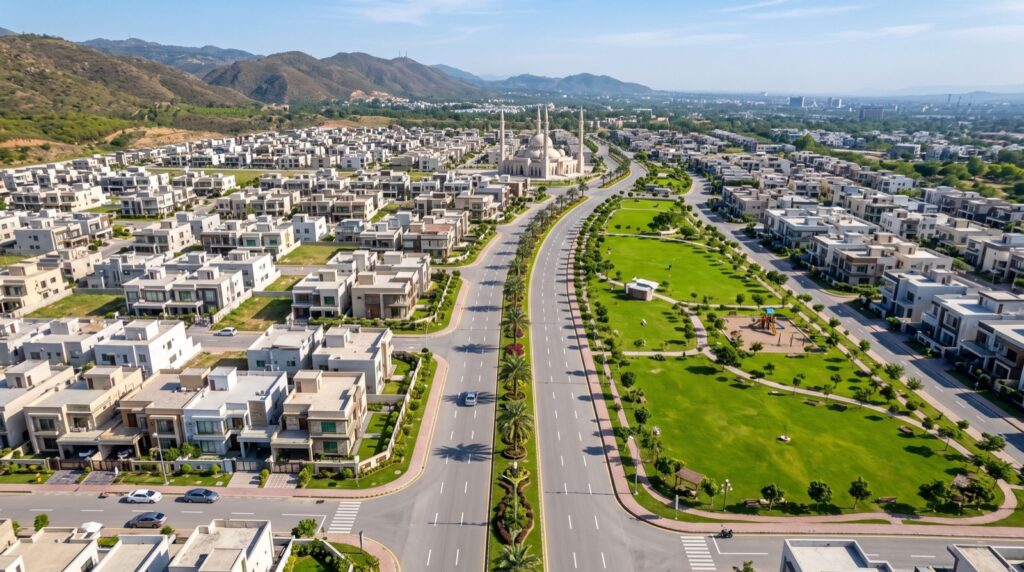
Master-planned communities are the vehicles through which most of this corridor growth reaches ordinary buyers. A New housing society Rawalpindi buyers frequently shortlist sits on the GT Road side with Ring Road connectivity, which is precisely the two-driver overlap the table above rewards: established access today plus new infrastructure tomorrow.
Why Is Vertical Development Gaining Ground?
Land near the city core is finite, and the arithmetic of a single plot changes completely when you can build upward on it. Regulators in both cities have grown friendlier to multi-storey approvals, and developers have responded by carving out zones specifically for apartments, offices and mixed-use towers.
For investors, vertical zones offer two advantages. One plot can host dozens of rentable units, multiplying income per marla. And apartment demand is structurally rising, since young professionals and small families increasingly prefer secure, serviced buildings over standalone houses they must maintain themselves.
There is a practical caveat: high-rise economics depend on approvals for height, parking ratios and firefighting compliance. Before paying a premium for a tower-zoned plot, confirm the permitted number of floors in writing, because the difference between six storeys and ten storeys is the difference between an average deal and an excellent one.
Dedicated inventory has followed the trend. Offerings such as High Rise Plots in Islamabad are sold with multi-storey construction rights attached, letting a mid-sized investor participate in the apartment economy without buying an entire building.
Rental Yields and the Management Question
Yield is where spreadsheets meet reality. Residential rentals in populated sectors of the twin cities typically return modest single digits annually on current values, while well-placed commercial units and apartments do better. The spread between a managed and a neglected property, however, can exceed the spread between corridors.
Vacant months, unpaid utility bills and slow repairs quietly destroy returns. Landlords who treat upkeep as a professional function, the way households hand recurring chores to reliable local experts rather than letting them pile up, keep tenants longer and re-let faster. Budget one month of rent per year for maintenance and treat it as non-optional.
Documentation discipline compounds the effect. A written tenancy agreement, police verification of tenants and rent collection through bank transfer protect you legally and create the paper trail that makes the property easier to sell later. Buyers pay more for a unit with a clean, verifiable rental history than for an identical unit with cash-in-hand ambiguity.
Ground Rules for First-Time Investors
Most losses in this market trace back to process failures rather than market crashes. Buyers skip verification because a dealer seemed trustworthy, or they stretch into an installment plan that assumed a bonus which never arrived. A short set of non-negotiable rules prevents almost all of it.
- Verify the scheme’s NOC with the development authority before discussing price with any dealer.
- Prefer possession-ready or near-possession inventory over far-off files unless you are explicitly speculating.
- Match the asset to your horizon: apartments and shops for income, corridor plots for five-year appreciation.
- Never finance installments with borrowed money that has its own repayment clock.
- Record every payment through banking channels and keep the file transfer-ready at all times.
Frequently Asked Questions
How much money do I need to start investing in Rawalpindi property?
Installment plans have lowered the entry bar considerably. Bookings in emerging schemes start with a down payment equivalent to a fraction of total value, with the balance spread over two to four years. The real requirement is dependable cash flow for every quarter of the plan.
Which is safer in 2026, plots or apartments?
Safety depends on approvals and location more than asset type. An approved plot in a developing corridor is a growth play; a completed apartment in a populated zone is an income play. Diversifying across both, if capital allows, smooths the ride.
When is the right time to exit a corridor investment?
Infrastructure investments reprice in steps: announcement, construction, and operation. The largest jump usually lands when the road or interchange actually opens and daily usage proves the connectivity. Selling into that operational phase, rather than the rumor phase, has historically captured the fuller gain.
Conclusion
The opportunity in Rawalpindi real estate investment this year is real but unevenly distributed. Corridors with double drivers, vertical zones with construction rights, and managed rentals are pulling ahead of passive file-flipping. Pick one corridor from the table, verify approvals with your own eyes, and place your 2026 capital where the infrastructure is being poured, not merely promised.